Why roofs leak around solar panels
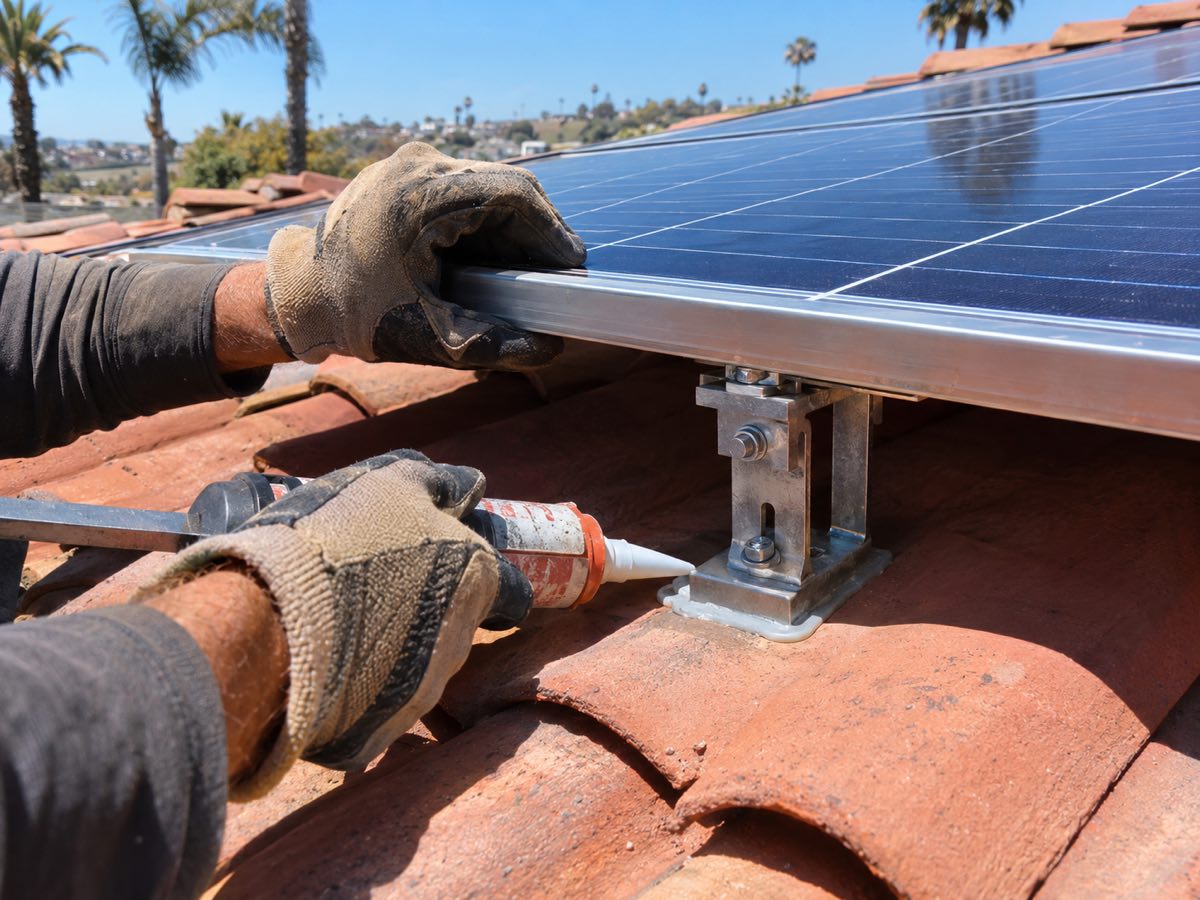
Most solar-related roof leaks come from failed seals at mounting points, tiles cracked during installation, or water dammed by debris under the panels. Each panel array is bolted to the roof through mounting feet, and every bolt is a hole in the roof that relies on flashing or sealant.
Common causes we find:
- Mounting feet without proper flashing, sealed only with caulk that has dried out
- Cracked tiles from installers walking on the roof
- Tiles that were cut to fit mounts and no longer shed water
- Leaves and debris trapped under panels, holding water against the roof
- Conduit penetrations through the roof that were never sealed well
Signs of a solar-related leak
- A stain on the ceiling under the panel array
- Leaks that started after solar installation
- Broken tile pieces near the array
- Debris build-up visible under the panel edges
How we repair leaks around solar panels
- Inspect the array from the roof and attic. We find which mount or penetration is leaking.
- Work with the panel layout. Small repairs can often be done without removing panels.
- Re-flash leaking mounts with proper flashing, not just sealant.
- Replace broken tiles under and around the array. See broken roof tile replacement.
- Clear debris from under the panels.
How solar panels attach to your roof
Most residential arrays sit on rails bolted to the roof through mounting feet. On shingle roofs, the feet go through the shingles into the rafters, with a flashing that slides under the shingle above. On tile roofs, installers either replace tiles at each mount with metal flashed replacement tiles, or cut tiles around a hook that reaches the rafter below. Every one of these points depends on correct flashing to stay dry.
| Roof type | Common mount type | Typical leak cause |
|---|---|---|
| Asphalt shingle | Flashed foot bolted to rafter | Missing or misaligned flashing, sealant-only mounts |
| Concrete tile | Tile hook or flashed replacement tile | Cracked tiles, gaps around hooks, torn underlayment |
| Clay tile | Tile hook or replacement tile | Cracked tiles from foot traffic, poor tile cuts |
| Flat roof | Ballasted or bolted racking | Unflashed penetrations, punctured membrane |
Leaks that start years after installation
Not every solar leak shows up right away. Sealant around a mount can last a few years before it cracks. A tile cracked during installation may hold until a heavy storm. If your leak started years after the panels went on, the cause can still be the installation, and checking your contract's roof warranty is still worth it.
Removing and reinstalling panels
When the roof under the array needs work, the panels must come off. This adds a separate step that involves a solar contractor. In the City of San Diego, reinstalling panels removed for roof renewal requires an electrical permit. We schedule the sequence so the roof work happens while the panels are off, and plan it with your solar company.
When panels need to come off
Some repairs, such as underlayment replacement under the array, require removing the panels. In the City of San Diego, when roof-mounted solar panels are removed to renew the roof covering, an electrical permit is required to reinstall them. We coordinate the work with a licensed solar contractor. Read our roof permit guide.
Your solar warranty and your roof
Many solar contracts include a roof penetration or workmanship warranty from the installer. Check yours before paying for a repair. We give you photos and a written report so you can file a claim with the installer if the damage is theirs.
Planning solar on an older roof?
If your roof is near the end of its life, repair or replace it before solar goes on. Removing and reinstalling panels later adds cost. A free roof inspection tells you how much life your roof has left.
Before you go solar: a roof checklist
- Is the roof under the planned array less than halfway through its life?
- On tile roofs, has the underlayment been checked under the array area?
- Are there broken tiles or failed flashing that should be fixed first?
- Does your solar contract include a roof penetration warranty, and for how long?
- Who will walk on the roof, and how will they protect the tiles?
Fixing the roof first costs less than removing and reinstalling panels later.
Birds and debris under panels
The space under solar panels shelters pigeons and collects leaves. Nests and droppings hold water against the roof and block drainage. Critter guards around the array keep birds out. We clear debris during repairs and can install guards once the roof is sound.
Related repairs
Where we do this work
We do this repair across San Diego. It's especially common in roof repair in University City and Sorrento Valley, roof repair in Mira Mesa. See all neighborhoods we serve.
Solar roof leak questions
Will a roof repair void my solar warranty?
It depends on your solar contract. Some warranties require the installer to do roof work around the array. Check your contract first, and we'll coordinate with the installer when needed.
Can you fix a leak without removing the panels?
Often, yes. Mount and tile repairs can usually be reached around the panels. Underlayment work under the array is the main exception.
Do pigeons under solar panels cause leaks?
Nesting material and droppings trap water and block drainage under the array. Clearing it out and installing critter guards helps.
Who should I call first, my roofer or my solar company?
If the leak started soon after installation, call your solar company first. If the installer is out of business or the warranty has expired, call a roofer to find and fix the cause.
Can solar panels protect my roof?
Panels shade the roof below them, which can slow sun damage. The same panels make the roof under them harder to inspect and repair, so keep up with checks around the array.
How much does it cost to remove and reinstall solar panels?
It depends on the number of panels and the solar contractor's rates, and it's quoted by the solar company, not the roofer. Fixing the roof before solar goes on avoids this cost.
Can a solar leak damage my roof deck?
Yes. A slow leak at a mount can wet the deck for several seasons before a stain appears inside, which is why mounts should be checked during roof inspections.