What is a torch-down roof?
A torch-down roof is a flat-roof system made of modified bitumen sheets whose seams are melted together with a propane torch to form a continuous waterproof layer. Modified bitumen is asphalt blended with polymers to make it more flexible and durable. It usually goes down in two or three layers: a base sheet and a mineral-surfaced cap sheet on top.
Modified bitumen roofs typically last around 20 years, according to InterNACHI. Repairs can extend that when the rest of the membrane is sound.
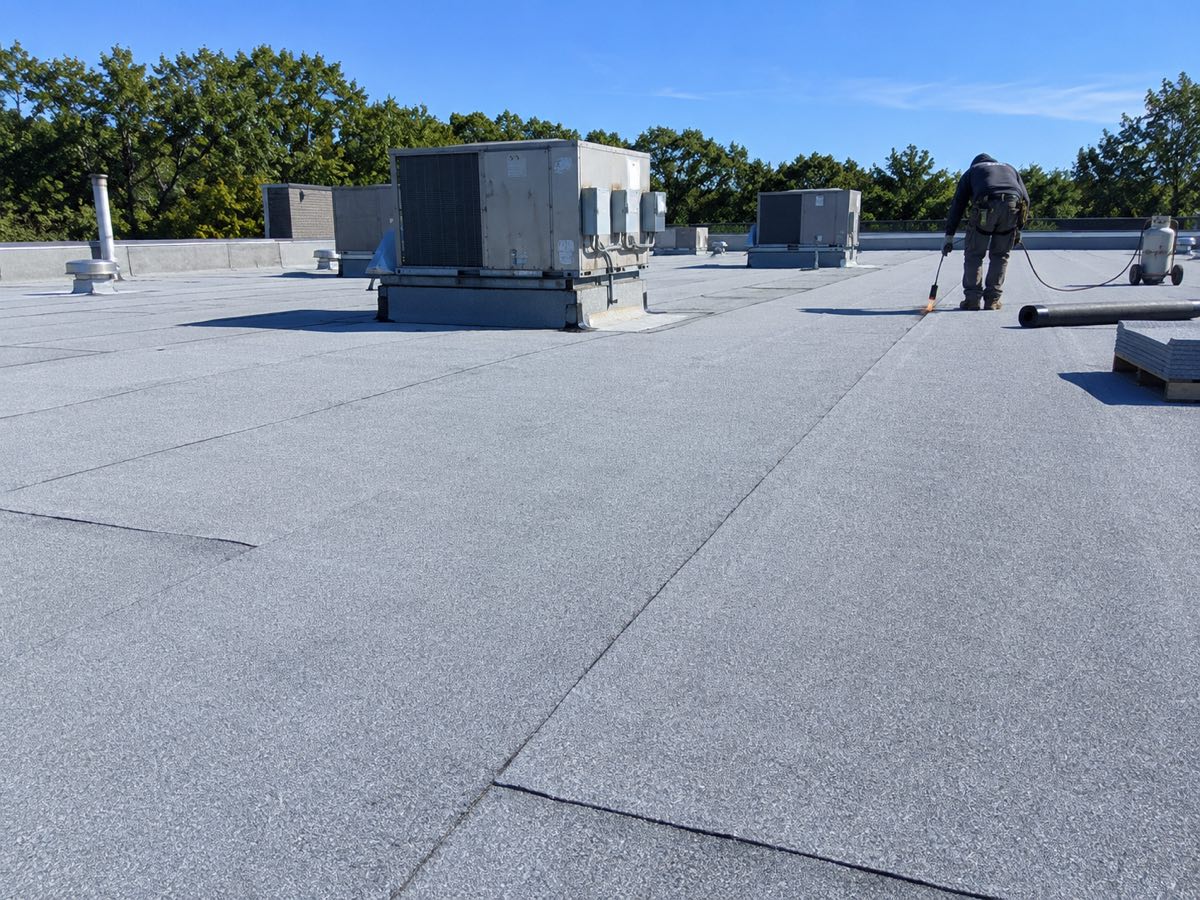
APP vs SBS modified bitumen
| Type | What it is | Typical installation |
|---|---|---|
| APP (atactic polypropylene) | Plastic-modified, stiffer, handles heat well | Torch-applied |
| SBS (styrene-butadiene-styrene) | Rubber-modified, more flexible | Torch-applied, cold adhesive or self-adhered |
Both are repaired with compatible modified bitumen. We identify which you have before patching.
Signs your torch-down roof needs repair
- Open or lifting seams where the sheets overlap
- Blisters or bubbles in the surface
- Bare spots where the mineral granules have worn away, exposing black asphalt
- Cracks, often in a crazed pattern on old cap sheet
- Ponding water that stays more than a day or two
- Loose flashing at walls, parapets and curbs
Why torch-down roofs leak
- Seams. A seam that wasn't fully fused, or that has aged and opened, is the most common leak point.
- Flashing at walls and parapets. Membrane turned up a wall pulls away or cracks at the corner.
- Penetrations. Pipes, vents and AC lines through the roof need proper flashing.
- Sun. UV breaks down exposed asphalt once the granules wear off.
- Foot traffic on roof decks and around equipment wears the cap sheet.
How we repair torch-down roofs
- Find the leak. Water travels under the membrane, so we check seams, flashing and penetrations uphill of the stain.
- Cut out damaged membrane around blisters, cracks and failed seams.
- Dry and prime the area so new material bonds.
- Torch new modified bitumen over the repair, lapped past the damaged edges.
- Re-flash walls, curbs and penetrations as needed.
- Check drains and slope, so water doesn't sit on the repair.
Fire safety with torch-applied roofing
Torch-down uses an open flame on the roof. Roofers must take care near wood, eaves, vents and anything flammable, and should keep a fire extinguisher at hand and watch the area after torching. In some spots, such as against wood siding or under eaves, a torch shouldn't be used at all; we switch to self-adhered or cold-applied material there.
Torch-down vs coatings
A roof coating can extend the life of a torch-down roof that's in fair condition. It won't fix open seams, wet insulation or failed flashing, and it must be compatible with the membrane. We repair the defects first, then discuss a coating if it makes sense.
How much does torch-down repair cost?
Small patches and seam repairs are among the less expensive roof repairs; flashing work and larger sections cost more. See typical ranges in the roof repair price guide.
Repair or replace a torch-down roof?
Repair makes sense when problems are limited to seams, a few blisters or one area. If the cap sheet is cracked and bare across most of the roof, or the insulation underneath is wet, replacement is usually more economical. See flat roof repair for the other flat roof systems we work on.
Where torch-down roofs are common in San Diego
- Beach cottages and duplexes in Pacific Beach, Mission Beach and Ocean Beach
- Flat roofs behind parapet walls on Spanish Revival homes in Kensington and Normal Heights
- Room additions, garages and patio covers across the city
- Small commercial and mixed-use buildings
Each setting brings its own repair issues: sand and roof-deck traffic at the beach, parapet flashing on Spanish homes, and the joint where an addition meets the original roof.
Caring for a torch-down roof
- Clear drains and scuppers before the rainy season and after windy days.
- Look for exposed black areas where granules have worn off, and have them coated or patched.
- Keep foot traffic to walkways, especially on roof decks.
- Check seams and wall flashing once a year.
- Fix blisters and splits early, before water gets into the layers below.
What a torch-down repair visit includes
We find the leak source, cut out failed material, dry and prime the area, torch or adhere new modified bitumen with proper laps, re-flash walls and penetrations where needed, and check drainage. You get photos of the problem and the finished repair.
Related repairs
Torch-down questions
How long does a torch-down roof last?
Modified bitumen roofs typically last around 20 years, depending on the number of layers, sun exposure and foot traffic. Repairs and coatings can extend that.
Can a torch-down roof be patched?
Yes. Patching with compatible modified bitumen is the standard repair for seams, blisters and small damaged areas.
Is it safe to torch near my house?
It is when done carefully, with fire precautions. Where a flame would be risky, we use self-adhered or cold-applied materials instead.
Can I walk on my torch-down roof?
Occasional walking is fine. Regular traffic, like on a roof deck, wears the cap sheet, so use walkway pads or a deck system that protects the membrane.
What does a torch-down roof look like?
Torch-down usually has a gray, white or tan granular surface in rolled strips, with overlapping seams every few feet. Older ones may look black where granules have worn off.
Can you put a coating on my torch-down roof?
Yes, if the roof is sound and the coating is compatible. We repair seams and blisters first, because coatings don't fix those.