What is roof flashing?
Roof flashing is thin metal, usually galvanized steel, aluminum or copper, installed where the roof meets another surface to direct water away from the joint. Without flashing, water would run straight into those seams.
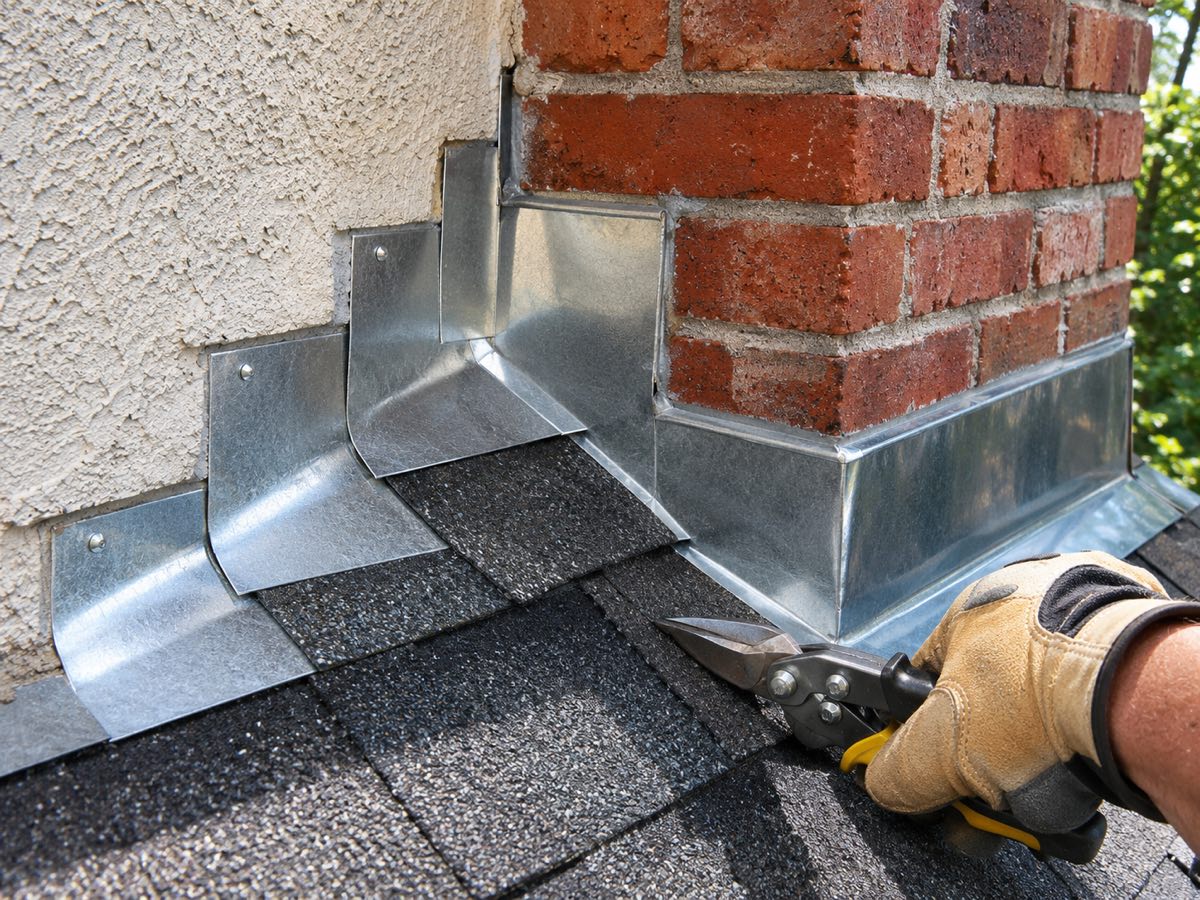
Types of flashing we repair
| Flashing | Where it is | How it fails |
|---|---|---|
| Step flashing | Where a sloped roof meets a side wall | Rust, missing pieces, stucco cracks above |
| Counter flashing | Covers step flashing on walls and chimneys | Pulled loose, sealant gone |
| Valley flashing | Where two roof slopes meet | Rust, debris build-up, gaps under tiles |
| Headwall flashing | Where the top of a roof meets a wall | Water runs behind it |
| Chimney flashing | Around the base of a chimney | Cracked mortar, rust, open corners |
| Skylight flashing | Around skylight curbs | Failed seals, wrong installation |
| Drip edge | Along eaves and rakes | Bent or missing, water reaches fascia |
Signs of failed flashing
- Leaks where the roof meets a wall or chimney
- Stains on interior walls below a roof-to-wall joint
- Rusted, bent or lifted metal visible from the ground
- Thick layers of old sealant or caulk, which often means past patches
- Stains on fascia boards along the eaves
Why flashing fails in San Diego
- Salt air. Near the coast, in Point Loma, Ocean Beach and Pacific Beach, salt corrodes steel flashing and fasteners faster.
- Sun. Sealant used at flashing joints dries and cracks.
- Stucco walls. Stucco cracks above step flashing can let water run behind the metal.
- Tile roofs. Valley and wall flashing under tiles is hidden, so rust goes unnoticed until it leaks.
Flashing on tile roofs vs shingle roofs
On shingle roofs, step flashing is woven between rows of shingles along a wall, and most of it is visible near the joint. On tile roofs, flashing is larger and sits mostly under the tiles, with pans that carry water down the roof. Because tile flashing is hidden, rust and debris build-up go unnoticed until a leak appears. Fixing it means lifting the tiles along the joint. See tile roof repair options.
Flashing materials
| Material | Strengths | Things to know |
|---|---|---|
| Galvanized steel | Strong, common, affordable | Rusts once the coating wears, faster in salt air |
| Aluminum | Light, resists rust | Can corrode in contact with some other metals and masonry |
| Copper | Very long-lasting | Higher cost; can stain surfaces below it |
| Pre-painted metal | Matches trim colors | Paint protects; scratches can start rust |
We choose metals that work with your roof, wall material and distance from the ocean.
Stucco walls and flashing
Many San Diego homes have stucco walls meeting the roof. Where the flashing runs up a stucco wall, it's usually covered by the stucco or by a counter flashing set into it. Cracks in the stucco just above the roof line let water get behind the flashing. A proper repair sometimes means cutting back a strip of stucco, installing new flashing, and patching the stucco over it. We explain this before work starts, because the stucco patch may need painting to match.
Skylight leaks
Most skylight leaks come from the flashing around the curb, not the glass. Old skylights with failed seals or cracked domes can leak too. We check the flashing, the curb and the skylight itself, and repair or reflash as needed.
How we repair flashing
- Find the failed section. We trace water stains back to the joint.
- Remove the roofing around it. On tile roofs we lift tiles; on shingle roofs we remove shingles near the joint.
- Replace the flashing with new metal, lapped correctly so water runs over each joint.
- Integrate with the wall. Counter flashing is set into or sealed against the wall surface.
- Reinstall roofing and test where possible.
We replace failed flashing rather than smear more sealant on it. Sealant-only repairs tend to fail within a few seasons.
How much does flashing repair cost?
Flashing repairs cost more than simple shingle or vent repairs because roofing must be removed around the joint, and chimney flashing costs more than wall flashing. See ranges in our roof repair cost guide.
Valley flashing: where two slopes meet
A valley carries water from two roof slopes, so it handles more water than any other part of the roof. On tile roofs, valley flashing sits under the tiles at the edges of the valley. Leaves, needles and tile debris collect there and dam the water, and rust eats through older steel valleys. A leaking valley often shows as a stain near an inside corner of a room. The fix is to lift the tiles along the valley, replace the metal, and reset the tiles with the valley clear.
Chimney leaks: finding the real cause
| Cause | What you'll see |
|---|---|
| Failed chimney flashing | Stains on the ceiling or wall next to the chimney |
| Cracked chimney crown | Water inside the chimney, stains on the firebox |
| Missing chimney cap | Water and debris inside the flue |
| Porous or cracked masonry | Damp brick inside the attic, efflorescence (white deposits) |
We check each before quoting, so you don't pay to replace flashing when the crown is the problem.
Related repairs
- Roof leak repair
- Tile roof repair
- Leak repair around solar panels
- Chimney flashing leak repair
- Skylight leak repair
Where we do this work
We do this repair across San Diego. It's especially common in roof repair in North Park, Normal Heights and Kensington, roof repair in Point Loma and Ocean Beach, roof repair in Pacific Beach and Mission Beach. See all neighborhoods we serve.
Flashing questions
Can flashing be repaired without removing tiles or shingles?
Small gaps in exposed counter flashing can be resealed in place. Step and valley flashing sit under the roofing, so it must be lifted to repair them properly.
What flashing metal is best near the coast?
Corrosion-resistant metals and coatings last longer in salt air. We recommend the material based on how close you are to the ocean and what touches it.
Is a chimney leak always a flashing problem?
No. Chimney leaks can come from cracked masonry, a missing chimney cap or a failed crown. We check all of them.
How do I know if my flashing is failing?
Leaks at walls, chimneys or skylights, rusted metal and heavy layers of old caulk are the main signs. Interior stains below a roof-to-wall joint point to flashing almost every time.
How long does roof flashing last?
It depends on the metal, the coating and how close the home is to the ocean. Flashing near the coast generally corrodes faster than inland.
Can I paint rusted flashing?
Paint can slow surface rust, but it won't fix flashing that has rusted through or separated. Once metal is thin or holed, it needs replacing.
Why does my wall leak only in heavy rain?
Wind-driven rain is pushed against walls and up behind flashing. A small gap that stays dry in light rain lets water in during storms. That pattern points strongly to wall flashing or stucco cracks just above the roof.